



In this Story
Share


Solar Subsidy in India: A Complete State-Wise Guide (2026)
Going solar starts with one question most households ask: how much subsidy can I actually get? The answer involves a central government scheme, your state's own rules, and your local electricity distribution company (DISCOM).
As per data from Premier Energies' Q4 FY2026 & FY2026 investor presentation (citing MNRE), India added around 44.6 GW of new solar capacity in FY2026 that nearly doubled what was added in FY2025. This guide breaks down what the subsidy is, how much you can get, how it differs from state to state and exactly how to apply for it.
What Is PM Surya Ghar Muft Bijli Yojana?
PM Surya Ghar: Muft Bijli Yojana is the Government of India's flagship scheme for residential rooftop solar. It provides Central Financial Assistance (CFA) that money credited directly to your bank account to eligible residential consumers who install a grid-connected rooftop solar system, once it's installed, inspected and net-metered.
As per the PM Surya Ghar guidelines published on the National Portal for Rooftop Solar, the current CFA structure is:
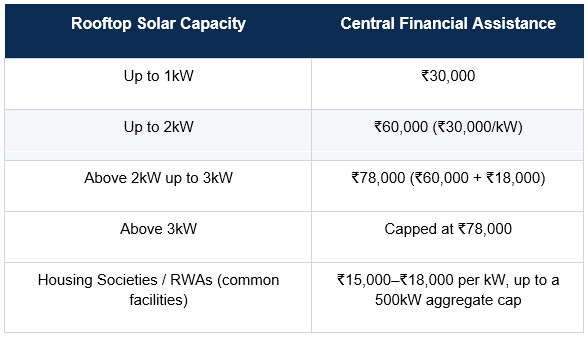
Most Indian homes need a 2-3 kW system, which means a typical household can qualify for the full ₹78,000 often covering close to a third of installation cost. Larger systems (5kW, 8kW, 10kW) don't get more central subsidy, but they benefit from lower per-watt costs on balance-of-system components.
Subsidy amounts and eligibility conditions are revised periodically. Always confirm current figures on the official PM Surya Ghar / National Portal for Rooftop Solar (pmsuryaghar.gov.in) and with your DISCOM before making a purchase decision.
Who Is Eligible and What About Commercial Solar?
The central CFA is built for residential rooftop consumers. You need an eligible residential electricity connection, suitable rooftop space and a grid-connected system that meets the scheme's technical requirements, applied for through the national portal and your DISCOM.
This subsidy is not available for commercial or industrial installations. Businesses need to evaluate solar on its own economics such as electricity tariffs (typically higher than residential, so payback is often faster), system size, financing and state-specific regulations. Even without capital subsidy, commercial rooftop or captive solar is frequently worthwhile for businesses with high daytime consumption, since it directly offsets grid electricity costs.
Why Net Metering Matters
Net metering is the billing mechanism that makes rooftop solar pay off faster. Your system generates electricity during the day; your home consumes what it needs and eligible surplus is exported to the grid and credited against your consumption. How exactly that credit is calculated and from what capacity net metering applies depends on your state's regulations, which is one reason the same system size can deliver different savings in different states.
Solar Subsidy, State by State (2026)
The central subsidy is uniform nationwide, but your actual experience is approval speed, additional incentives, net-metering rules that depend heavily on your state and DISCOM.
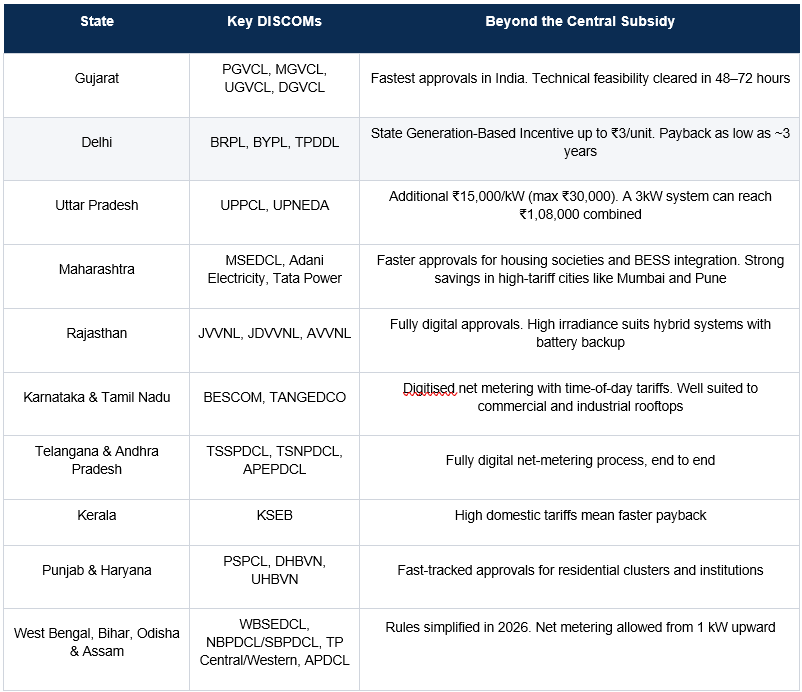
Don't assume a benefit available in one state applies elsewhere. Always confirm current rules with your state electricity regulator and DISCOM before calculating expected savings. The national portal remains the single point of application regardless of state.
One Thing to Check Before You Buy: Is the Panel on the Approved List?
This matters directly for your subsidy, so it's worth knowing. Under PM Surya Ghar, only panels listed on MNRE's Approved List of Models and Manufacturers (ALMM) qualify for the subsidy. If your installer proposes a panel that isn't ALMM-listed, your subsidy claim can be rejected. So it's worth confirming this with your installer upfront, before installation begins.
Beyond that, you don't need to become a technical expert to go solar. A reliable installer will guide you on system size and equipment. Your job is mainly to confirm the subsidy eligibility and get quotes from more than one registered vendor.
How to Apply for the Subsidy
- Register on the National Portal for Rooftop Solar using your DISCOM consumer number
- Submit a technical feasibility request
- Choose a registered, empaneled installer in your DISCOM's service area
- Install ALMM-listed panels and compliant system components
- Complete DISCOM inspection and net-meter installation
- Upload commissioning certificate, system details and bank-cancelled cheque details
- Receive the CFA credited directly to your bank account, typically within weeks of verification
You'll typically need a recent electricity bill, ID proof, property ownership or tax record, bank details, and the DISCOM-signed net-metering agreement.
Because requirements change, treat the official portal, not third-party summaries as the authoritative source at each step.
---
Sources
- PM Surya Ghar: Muft Bijli Yojana / National Portal for Rooftop Solar (pmsuryaghar.gov.in)
- Ministry of New and Renewable Energy (MNRE), including ALMM guidelines (mnre.gov.in)
- Premier Energies Q4 FY2026 & FY2026 Investor Presentation
- Kiwa PVEL PV Module Reliability Scorecard
- State electricity regulatory commissions and DISCOM websites (Gujarat, Delhi, Uttar Pradesh, Maharashtra, and others) for current state-specific rules
Note: Solar subsidy amounts, state incentives and net-metering regulations may be revised periodically. Verify the latest provisions via PM Surya Ghar, MNRE, and your DISCOM before making an investment decision.
Frequently asked questions


Eligible residential consumers can receive central assistance up to ₹78,000 for a 3kW or larger system, with some states adding further incentives on top. Always verify current rates on the official portal.
No. The residential CFA doesn't extend to commercial or industrial systems. Businesses should evaluate solar based on tariff savings, state regulations and financing options instead.
States like Uttar Pradesh and Delhi add cash or per-unit benefits. Most others follow the central structure with faster processing or digitised net metering as their main advantage.
Generally within a few weeks of system commissioning, DISCOM inspection and net-metering approval timelines vary by state and DISCOM workload.


