


In this Story
Share


3kW, 5kW & 10kW Solar System Price in India (2026): Complete Cost & Subsidy Guide
Electricity tariffs across India have climbed steadily, and rooftop solar has shifted from a "nice-to-have" to a straightforward financial decision for homes and small businesses. If you're searching for the 3kW solar panel price in India, 5kW solar panel price in India or 10kW solar panel price in India, the number you see online is only a starting point; the final cost depends on the modules, inverter, mounting structure, electrical protection, roof condition, installation complexity, location and applicable subsidy.
The more useful question isn't "what's the price" but which system size matches your electricity consumption, roof area and future energy needs. This guide breaks down 2026 pricing for 3kW, 5kW and 10kW systems, the exact PM Surya Ghar subsidy slabs, expected generation, payback periods and the factors that move a quotation up or down.
3kW, 5kW and 10kW Solar System Price in India
As an indicative planning range, a complete on-grid rooftop system inclusive of modules, inverter, structure, cabling and standard installation may cost:
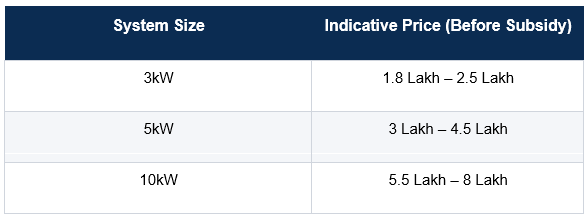
These are indicative ranges, not fixed prices. Actual cost shifts with module technology, inverter selection, roof structure, installation complexity, location, system configuration and subsidy eligibility. Off-grid or hybrid systems with battery storage cost more.
What's Included in the System Price
A solar system is more than the modules on your roof. A typical grid-connected installation includes:
- Solar modules - Convert sunlight into DC electricity and typically account for 45-50% of total cost. Modern N-Type TOPCon modules are designed for higher conversion efficiency and lower degradation than older Mono PERC modules.
- Solar inverter - Converts DC output into usable AC power. String inverters suit most homes; larger systems may use hybrid or three-phase inverters.
- Mounting structure - Engineered for the roof type and local wind/load conditions, usually galvanised or aluminium.
- Balance of System (BOS) - Cabling, junction boxes, AC/DC protection, earthing, surge protection and monitoring.
- Installation and commissioning - Site survey, structural work, electrical connections, testing and net-metering liaison.
Because each component affects performance and safety, comparing systems only on solar panel price per watt gives an incomplete picture. The module is one part of a larger system.
PM Surya Ghar Subsidy: What You Actually Get
Under PM Surya Ghar: Muft Bijli Yojana, the central financial assistance (CFA) is structured in fixed slabs, not a flat percentage:
- ₹30,000 per kW for the first 2kW
- ₹18,000 for the 3rd kW
- Capped at ₹78,000 for any system of 3kW capacity or above
This means a 3kW, 5kW and 10kW system all receive the same maximum central subsidy of ₹78,000 for capacity beyond 3kW isn't subsidised further, but it generates significantly more electricity and delivers greater long-term bill savings. Several states offer additional top-up subsidies on the central amount, so check with your state nodal agency before finalising a quote. Eligibility and disbursement remain subject to scheme guidelines and DISCOM processes. (Source: MNRE, PM Surya Ghar portal)
3kW vs 5kW vs 10kW: Full Comparison
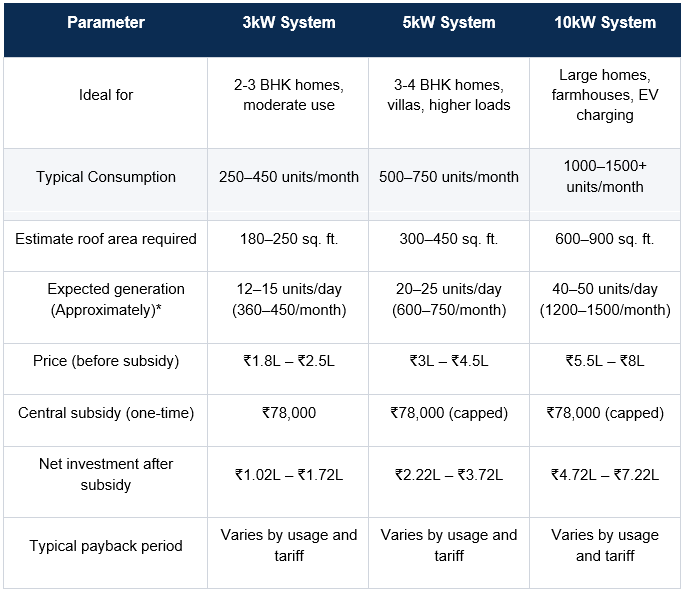
*Generation figures are indicative estimates only and are not guaranteed. Actual generation depends on the location’s solar irradiation, roof orientation, shading, temperature, system design, system losses and inverter performance, so different systems of the same size can generate different amounts.
For an estimate specific to your site, please reach out to us.
Payback period depends on the installed cost after subsidy, your local electricity tariff, monthly self-consumption, exported electricity compensation, annual generation and system maintenance. Higher consumption during daytime generally shortens payback.
For an estimate based on your own bill and roof, please reach out to us.
Generation figures assume standard sunshine hours and can vary based on location, shading, orientation, weather, system design and module efficiency. The central subsidy is a one-time credit against upfront cost, disbursed as per PM Surya Ghar scheme guidelines and DISCOM processing timelines; state-level top-ups, where available, can further reduce net investment.
3kW: Who Should Choose It
A 3kW system suits smaller independent homes with moderate consumption of lighting, fans, refrigeration, TV, washing machine and limited air-conditioning. It typically offers one of the fastest payback periods relative to investment.
5kW: Who Should Choose It
Best suited to larger homes and villas consuming 500-700 units/month, running multiple air conditioners or planning ahead for EV charging and other future loads.
10kW: Who Should Choose It
Suited to large independent homes, luxury villas, farmhouses and properties with EV charging or consumption above 1,000 units/month. System size should be chosen based on actual usage and future loads, not simply because a bigger system generates more power.
Why N-Type TOPCon Matters
TOPCon (Tunnel Oxide Passivated Contact) is a cell architecture designed to reduce energy losses and improve conversion efficiency. N-Type TOPCon modules can offer higher efficiency, lower degradation and better long-term performance than older cell technologies, depending on the specific design that is a meaningful advantage when roof space is limited.
Module technology and manufacturing quality directly affect lifetime generation and ROI, which is why ALMM (Approved List of Models and Manufacturers) compliance is becoming mandatory for a wider range of projects. Warranty terms are a concrete way to evaluate this: Premier Energies' TOPCon modules, for instance, carry a 12-year product warranty and a 30-year performance warranty, with output guaranteed at no less than 85.4% of nominal power at the end of year 30.
Premier Energies has over 30 years of solar manufacturing experience and reports 11.1 GW of module manufacturing capacity and 10.9 GW of annual cell manufacturing capacity by FY2026, following a new 6.03 GW automated module facility. Its investor presentation identifies TOPCon G12R and zero-busbar cell technology among its core areas of expertise, and the company was among the first in India to manufacture a Zero Busbar TOPCon cell. Its facilities are ALMM-certified.
(Source: Premier Energies Q4 FY2026 & FY2026 Investor Presentation; pv magazine India)
For homeowners, this means shorter lead times, ALMM-compliant documentation for subsidy processing, and access to advanced N-Type TOPCon modules without relying on imported components. Premier Energies has also expanded into battery energy storage systems, inverters and transformers as part of its broader cleantech portfolio.
What Affects Solar Rooftop System Cost
Even two homes buying the same size can get different quotes.
Key drivers include:
- Module technology and efficiency (N-Type TOPCon vs older Mono PERC)
- Inverter brand, rating and configuration (basic grid-tied vs hybrid/battery-ready)
- Roof type - RCC roofs are generally simpler than tin, tile or unconventional shapes needing custom structures
- Installation complexity - Shadow-free area, roof height, cable routing, site accessibility
- Warranty and certification - ALMM-listed modules with strong product/performance warranties (e.g. 12-year product, 30-year performance) cost more upfront but reduce long-term risk
- Location - State DISCOM processes, net-metering charges and state-level subsidy top-ups
A low initial quote shouldn't automatically be treated as the best investment. Compare the complete system, expected generation, warranties, installation quality and after-sales support that is not just the price per watt.
How to Choose the Right System Size
Start with three numbers that include your average monthly electricity consumption, your current bill, and the expected generation from the proposed system. Also factor in future loads like additional air-conditioners, heat pumps or an EV. So the system you install today remains adequate as usage grows.
- 3kW - Smaller households, moderate use, fastest payback relative to cost
- 5kW - Medium to large homes with higher loads, planning ahead for EV charging
- 10kW - Large homes, farmhouses, high consumption or EV-heavy households
For an accurate recommendation, use your latest electricity bill, roof area and location rather than a generic online estimate.
Frequently asked questions


A 3kW rooftop system typically costs 1.8 Lakh – 2.5 Lakh before subsidy, with a maximum PM Surya Ghar subsidy of ₹78,000.
No. The central subsidy is capped at ₹78,000 for any system of 3kW or above, so larger systems don't receive proportionally more central support though some states offer additional top-ups.
N-Type TOPCon modules are increasingly preferred for new installations due to higher efficiency and lower degradation over the system's lifetime compared to older Mono PERC modules. Check the product and performance warranty terms, not just the technology name before finalising a supplier.


